A hairline design consultation determines where new grafts will be placed and how the finished result will frame your face. During this assessment, surgeons evaluate facial proportions, existing hair patterns, donor availability, and patient expectations to create a customized plan that delivers natural-looking results both immediately and as you age.
Initial Assessment and Patient History Review
The consultation begins with a comprehensive medical history review and scalp examination. Surgeons document current hair loss patterns using standardized classification systems like the Norwood-Hamilton scale for men or Ludwig scale for women, identifying areas of miniaturization and stable donor zones.
| Assessment Component | Purpose | Time Required |
| Medical history review | Identify contraindications and risk factors | 10-15 minutes |
| Scalp examination | Evaluate hair density, scalp laxity, donor quality | 15-20 minutes |
| Hair loss pattern analysis | Determine progression stage and future loss prediction | 10-15 minutes |
| Hairline design discussion | Create customized placement plan | 15-25 minutes |
| Graft calculation and documentation | Estimate required grafts and photograph agreed design | 10-15 minutes |
According to Hair Transplant Practice Guidelines published in PMC, hairline design documentation with photographs is essential, and the number of grafts planned versus actually performed should be disclosed to patients and recorded with images.
Surgeons assess scalp laxity by testing skin elasticity, which isn’t just about comfort during FUT procedures but also affects how well the scalp can accommodate new grafts. Hair caliber, density in donor areas, and existing hair direction all influence final design decisions.
Facial Proportion Analysis and Measurement Techniques
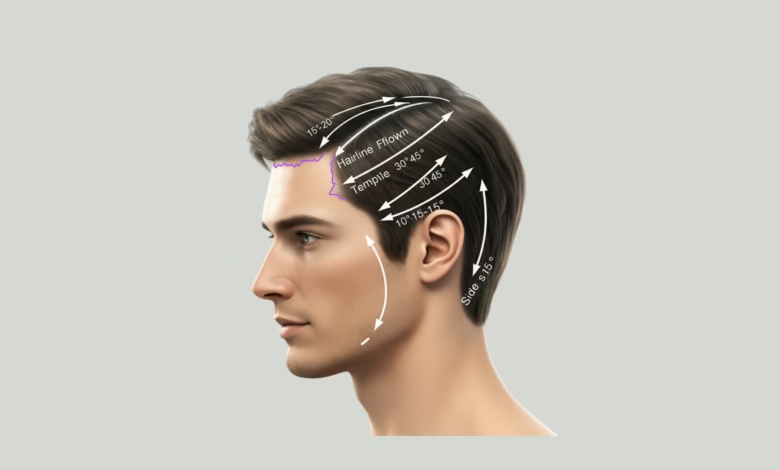
The surgeon measures specific facial landmarks to determine age-appropriate hairline placement. The distance from the glabella (the area between the eyebrows) to the proposed hairline typically ranges from 6-8 cm in adult males, though this varies based on facial structure and patient age.
Frontotemporal angles are assessed to create natural temple points that complement the central hairline. According to research on hairline design principles, natural hairlines aren’t perfectly symmetrical, so slight irregularities add realism and prevent the “pluggy” appearance of older transplant techniques.
The rule of thirds applies to facial aesthetics. The face divides into three roughly equal sections: hairline to eyebrows, eyebrows to nose tip, and nose tip to chin. A hairline positioned too low or too high disrupts these proportions, creating an unnatural appearance.
Design Principles for Natural Hairline Placement
Modern hairline design balances artistic judgment with scientific principles. Surgeons create irregular patterns using single-hair follicular unit grafts in the front row, transitioning to two-hair and three-hair grafts as density increases posteriorly.
According to studies on hairline training models in PMC, irregular zig-zag patterns mimic nature’s randomness better than straight lines. The hairline isn’t a solid line but rather a gradual transition zone where hair density progressively increases.
| Hairline Zone | Graft Type | Density (grafts/cm²) | Purpose |
| Anterior transition zone | Single-hair units only | 10-15 | Creates soft, feathered front edge |
| Frontal hairline | Single and double-hair units | 25-35 | Establishes primary visual frame |
| Temporal points | Single-hair units | 15-20 | Blends temples naturally |
| Mid-scalp transition | Double and triple-hair units | 35-50 | Builds volume and coverage |
Frontotemporal corners are more angular rather than rounded, which helps create a natural transition as the hairline moves toward the temples. This angular design is particularly important for younger patients who may experience further recession.
Customization Based on Age, Gender, and Hair Characteristics
Patient age significantly influences design decisions. Younger patients typically receive more conservative placements because hair loss often progresses beyond initial recession patterns. Surgeons must anticipate future thinning to ensure the hairline transplant remains appropriate decades later.
Women’s hairlines differ substantially from men’s. Female hairlines are lower, more rounded at temporal points, and maintain consistent density without significant recession. According to experts in hairline design, a well-trained hair transplant surgeon must educate patients on what will look good both immediately and in the future.
Hair characteristics like color, texture, and curl pattern affect design strategy. Dark, coarse hair on light skin requires greater density for adequate coverage compared to fine, light-colored hair. Curly hair provides more visual coverage per graft than straight hair, allowing for slightly lower density while maintaining natural appearance.
Ethnicity influences hairline shape expectations. Asian hairlines tend to be straighter with less temporal recession. African-Caribbean hairlines often feature tighter curl patterns requiring specific angulation techniques during graft placement.
Documentation, Mock-Up Design, and Patient Approval Process
Before finalizing the plan, surgeons create visual mock-ups using marking pens or digital imaging software. Patients view proposed hairline placement in mirrors from multiple angles, ensuring complete understanding of expected outcomes.
According to comprehensive guides on hair transplant hairlines, hairline design requires deep understanding of artistic principles, medical science, and long-term planning. The best results come from experienced surgeons who carefully consider each patient’s unique hair loss pattern, facial structure, and future needs.
Photography documentation captures the agreed design from frontal, lateral, and oblique angles. These images serve as references during the procedure and provide baseline comparisons for post-operative assessment. Patients receive copies of design documents outlining graft counts, distribution plans, and expected density in different zones.
The consultation isn’t complete until both surgeon and patient reach full agreement. Patients should feel comfortable asking questions about placement rationale, expected naturalness, and how the design will age. Reputable clinics like Vinci Hair Clinic encourage open dialogue to ensure expectations align with realistic outcomes.
Changes requested after the initial consultation are accommodated through follow-up discussions. Some patients prefer second consultations to review the design with fresh perspective, particularly when considering significant changes to facial framing.
What Hairline Design Is and What It Is Not
Hairline design is a collaborative process combining surgeon expertise with patient preferences to create age-appropriate, natural-looking placement that complements facial features and accounts for future hair loss patterns.
Hairline design isn’t a one-size-fits-all template applied uniformly to every patient, nor is it solely determined by patient requests without regard for anatomical limitations, donor availability, or long-term aesthetic outcomes.
The consultation represents the foundation of successful hair restoration. According to analysis of the art and science of hairline design, hairline design is where science, artistry, experience, and patient individuality meet to frame the face, define symmetry, and set the tone for natural aesthetics.
Patients who invest time in thorough consultations, ask detailed questions, and work with experienced surgeons report higher satisfaction with final results. The hairline shapes first impressions and influences how others perceive age and vitality, making its design arguably the most critical aspect of the entire transplant procedure.