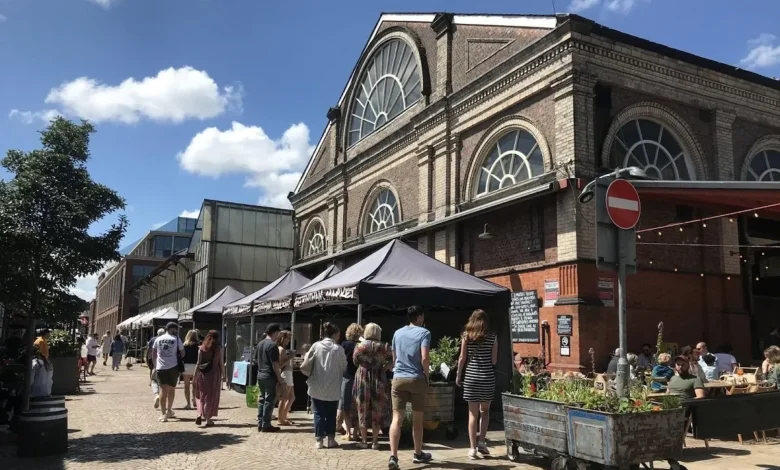
Introduction to altrincham market
Altrincham Market isn’t just a cluster of stalls—it’s a landmark that has reshaped how people think about food halls, community commerce, and destination markets in the UK. Its story begins in the 13th century, when Altrincham was first granted a market charter. At that time, the market served a purely practical purpose, connecting townsfolk, farmers, and travellers. But fast-forward more than 700 years, and this same location has transformed into one of Greater Manchester’s most beloved cultural hubs. What’s fascinating is how effortlessly the market blends nostalgia with forward-thinking entrepreneurship.
Today’s Altrincham Market is proof that old spaces don’t have to be mothballed or sanitised to feel relevant. Instead, the market’s operators embraced their heritage while encouraging creativity, craftsmanship, and modern food culture. When you walk in, nothing feels artificial or over-curated. Instead, the space buzzes with the kind of lived-in warmth that only grows organically, shaped by the vendors, the customers, and the stories exchanged between them.
Part of the market’s charm lies in its refusal to be static. It evolved from a traditional weekly market into a vibrant ecosystem of makers, bakers, and chefs. The reimagining of the Market House—once a simple hall, now a dynamic dining space—brought national attention and inspired a wave of food hall concepts around the UK. Markets from London to Liverpool have borrowed the Altrincham blueprint, but many visitors will tell you the original remains unmatched for atmosphere and soul.
Whether you visit on a chilly weekday morning or a packed weekend afternoon, the first thing you notice is how connected everything feels. Shoppers don’t sprint in and out—they stay, browse, sip, chat, and pull up a seat. That’s the magic of a truly successful market: it doesn’t just sell goods; it gently persuades you to belong for a while.
Food, Glorious Food: A Feast for Every Taste
If the historic market buildings are the skeleton, food is undoubtedly the lifeblood pumping through Altrincham Market. The Market House food hall acts like a communal dining room where small independent kitchens serve dishes bold enough to lure customers from across the region. This isn’t fast food, nor is it stuffy restaurant fare. The best word to describe it is real—honest, flavour-led, and proudly made from scratch.
The lineup of traders often reads like the menu of a trendy restaurant district: wood-fired pizza, freshly baked sourdough, seasonal small plates, and sizzling grills in one corner; artisan ice creams, bold desserts, and craft coffee in another. It’s the variety, but also the consistency, that makes dining at the market a genuine pleasure. You can return week after week, try something entirely different each time, and never feel like you’ve compromised on quality.
Another reason food lovers rave about the market is its respect for provenance. Traders are encouraged—not pressured—to work with regional producers. You’ll spot local farm names printed on chalkboards, hear vendors describe where their meats and vegetables come from, and even chat directly with suppliers at the outdoor market. This transparency builds trust, and trust builds loyalty. Customers aren’t just eating—they’re participating in a supply chain shaped by values.
Perhaps the most underrated aspect of food at Altrincham Market is its accessibility. Yes, the dishes are creative. Yes, they’re beautifully plated. But nothing feels intimidating or exclusive. Families tuck into pizza beside couples sharing wine and friends swapping bites of something new. You don’t need reservations, dress codes, or insider knowledge. You just show up hungry and ready to explore. And that approachability has helped transform the market into one of the North West’s most inclusive food spaces.
Makers, Creatives, and the Joy of Shopping Small
Step outside the dining hall and the market continues to hum with energy—this time from independent makers, artists, growers, and small traders. Altrincham Market has always been a trading post, but the modern revival has turned it into a launchpad for creativity. Many small businesses found their first customers here before expanding into full-time ventures. That’s the quiet power of markets: they nurture risk-takers by giving them space to try, sell, learn, and grow.
The marketplace is wonderfully eclectic. One stall may offer hand-thrown pottery while another showcases small-batch skincare. You’ll find handcrafted jewellery, children’s clothing, preserves, flowers, woodworking, and art prints—all sold by people directly involved in the making. Shoppers receive not just a product but a conversation: how something was made, what inspired it, and why it’s special. In a world of anonymous online shopping, that human connection feels like luxury.
What impresses many first-time visitors is the balance between tradition and reinvention. Alongside contemporary makers, you’ll still find the classic traders markets are known for: fruit and veg sellers, florists, cheesemongers, and bakers arriving early, setting up quickly, and greeting regulars by name. That mix keeps the market grounded. It honours its agricultural past while embracing a new creative economy built around craft and individuality.
Beyond economics, the independent stalls spark something more subtle: civic pride. Residents love knowing they have access not just to goods but to talent—people making things right here in the region instead of being lost in the global e-commerce machine. When you buy a candle, loaf of bread, or bunch of tulips from a stallholder you can talk to, you’re doing more than purchasing—you’re participating in a community that values work done with care.
A Gathering Space: Community at Its Core
Perhaps the greatest achievement of Altrincham Market isn’t its food, its stalls, or its carefully restored Victorian buildings—but the way it has become a meeting ground for every slice of life. Markets rarely succeed unless they feel welcoming, and that’s precisely where this one excels. Anyone who spends even half an hour here recognises that Altrincham Market is a space without barriers.
The Market House tables encourage strangers to sit side by side, share space, and maybe share stories. Parents with young children meet grandparents out for a stroll. Remote workers with laptops settle in alongside weekend browsers. Teenagers grabbing treats hover near regulars sipping their usual flat whites. It’s a setting that feels communal but never forced—you can be social without small talk, or chatty without obligation.
The market also runs events, themed days, and seasonal gatherings, further cementing its role as a cultural cornerstone. From festive markets to summer evenings spent outdoors with live music, it transforms with the calendar while still retaining its familiar warmth. These experiences shape emotional memory, the kind of attachment that goes far beyond simply liking a place.
Visitors often note how the market has helped catalyse Altrincham’s wider regeneration. When the market flourishes, nearby streets fill with independent cafes, boutiques, and studios. New residents arrive because the town feels vibrant. Property values shift—not just financially but socially. That ripple effect explains why people mention Altrincham Market not only as a place they enjoy but as a symbol of civic turnaround. It shows what happens when community spaces are invested in—not just economically, but emotionally and creatively.
Conclusion:
There is no shortage of markets across Britain—covered, outdoor, artisanal, traditional. But Altrincham Market stands apart for its balance of authenticity and innovation. It didn’t try to mimic London’s food courts or tourist-heavy markets. Instead, it redefined what a market could be by focusing on people first—traders, cooks, producers, neighbours, and curious visitors. That people-centric approach has been copied widely, but it’s difficult to replicate because it relies on culture more than strategy.
What makes the market a benchmark is that it delivers on multiple fronts: food excellence, design integrity, community participation, and entrepreneurial support. Many places manage one or two of these elements; few achieve all of them simultaneously while still feeling effortless. This is the type of place where you can drop in for a loaf of bread, stay for lunch, buy a gift, bump into friends, and leave feeling like the day unfolded naturally rather than being manufactured around you.
Another reason its model resonates is sustainability—not the buzzword used for marketing, but the practice of economic resilience. Independent businesses generate revenue locally. Customers’ spending recirculates within the town. Traders rise, evolve, and sometimes move on to bigger ventures, but the market remains a constant anchor. It’s a breathing organism rather than a retail format.
If anything, Altrincham Market proves that town centres can thrive again, not by chasing flashy chains or rapid development, but by nurturing character, entrepreneurship, and inclusivity. It invites other towns to rethink how public spaces are used—not as transactional zones but as cultural catalysts. Markets, when done right, are the heart of community life. And in the case of Altrincham, that heart beats proudly, purposefully, and with a rhythm many others aspire to replicate.